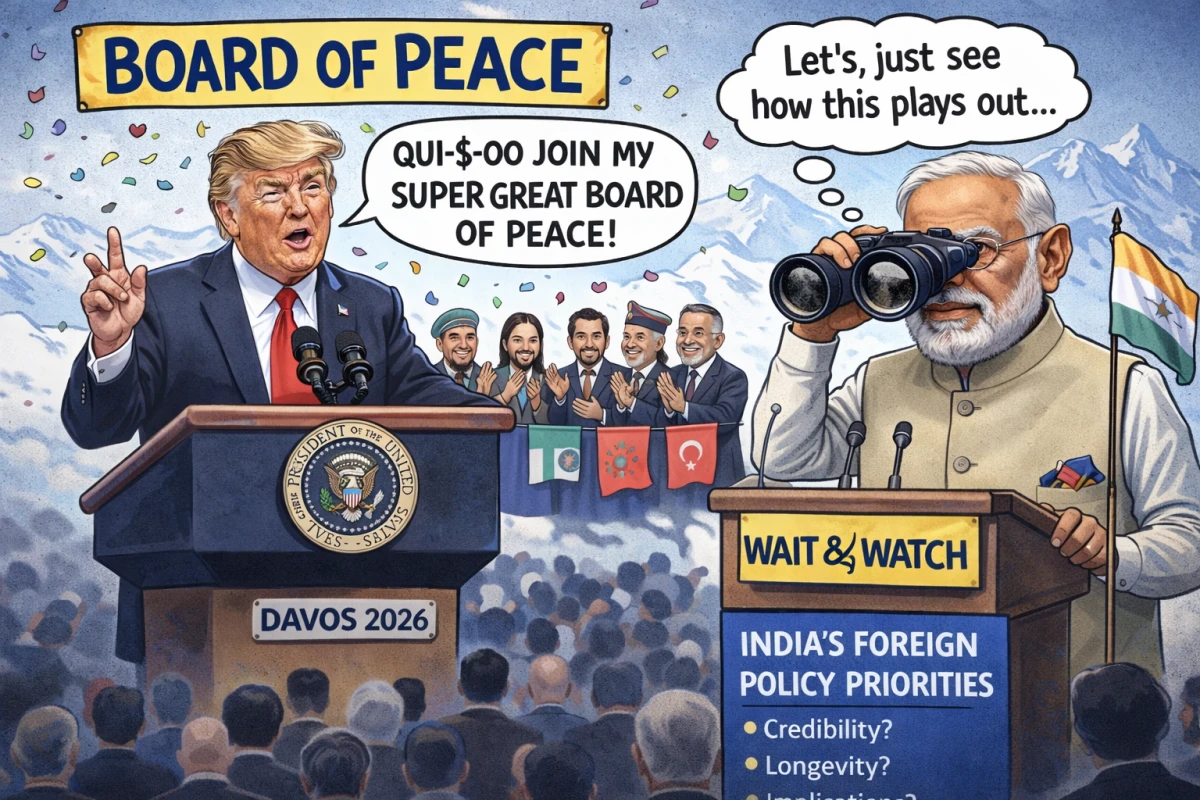

As U.S. President Donald Trump formally unveiled his ambitious Board of Peace at the World Economic Forum in Davos, India chose caution over commitment, neither accepting nor declining the invitation extended to Prime Minister Narendra Modi.
While several countries announced their participation, New Delhi stayed away from the ceremony on Thursday, signalling a deliberate “wait and watch” approach as it assesses the board’s credibility, longevity, and implications for India’s foreign policy priorities.
Last week, Canada had indicated its intention to join the board, only to see its invitation withdrawn following diplomatic tensions. India’s silence, however, appears calculated rather than reactive.
According to sources, India is evaluating multiple strategic factors before taking a call.
Composition and legitimacy
India is closely watching which countries ultimately form the board. While several West Asian nations such as Saudi Arabia, Egypt, Israel, the United Arab Emirates, Turkey, and Jordan have joined, most major European powers have stayed away. Permanent members of the United Nations Security Council, including Russia, China, France, and the United Kingdom, are also absent. In Delhi’s view, this raises questions about the board’s global weight and legitimacy.
Longevity of the initiative
There is concern that the Board of Peace is closely tied to Trump’s personal leadership. With his term ending in three years, Indian policymakers are assessing whether the initiative will survive beyond his presidency or risk becoming defunct, leaving members politically exposed.
Impact on multilateralism
India has traditionally supported the United Nations and a rules based multilateral order. There is unease that the Board of Peace could undermine the UN framework or operate as a parallel body, despite Trump’s assertion that it would function “in conjunction with the United Nations.”
Scope beyond Gaza
While the board was initially linked to stabilising Gaza after the Israel Hamas conflict, Trump has said its mandate would be global. India is wary of the board intervening in conflicts beyond Gaza, particularly in sensitive regional matters.
Pakistan factor
Pakistan Prime Minister Shehbaz Sharif attended the Davos ceremony. Indian officials believe Pakistan’s presence complicates India’s decision. Staying out could mean losing influence in future deliberations affecting regional security, while joining carries its own diplomatic risks.
Canadian Prime Minister Mark Carney has argued that the board should be limited to Gaza, in line with a UN Security Council resolution. India broadly aligns with this view and supports a negotiated two state solution to the Israel Palestine issue. However, Trump’s assertion that the board is “for the world” has added to Delhi’s caution.
Recent consultations between Prime Minister Modi and UAE President Mohamed bin Zayed underline India’s preference for quiet diplomacy over public commitments.
Beyond geopolitics, India’s response offers valuable leadership lessons for the workplace.
Strategic patience matters
Strong leaders do not rush decisions under pressure. They observe, analyse, and choose timing carefully.
Assess credibility before commitment
Whether joining a project, company, or leadership role, understanding long term viability is critical.
Balance principles with pragmatism
India’s stance reflects how leaders balance core values with real world consequences.
Influence requires presence, but presence requires caution
Staying engaged without immediate commitment can preserve options and leverage.
India’s decision to wait and watch underscores that leadership is not always about immediate action. Sometimes, restraint, clarity, and long term thinking define effective leadership.
For candidates and young professionals, the message is clear. Career growth depends not just on enthusiasm, but on judgment, patience, and the ability to read complex environments before making commitments.
#DonaldTrump #BoardOfPeace #IndiaUSRelations #Davos2026 #WorldEconomicForum #GlobalDiplomacy #IndianForeignPolicy #UnitedNations #GlobalPolitics #LeadershipLessons #SearchTalents #InternationalNews