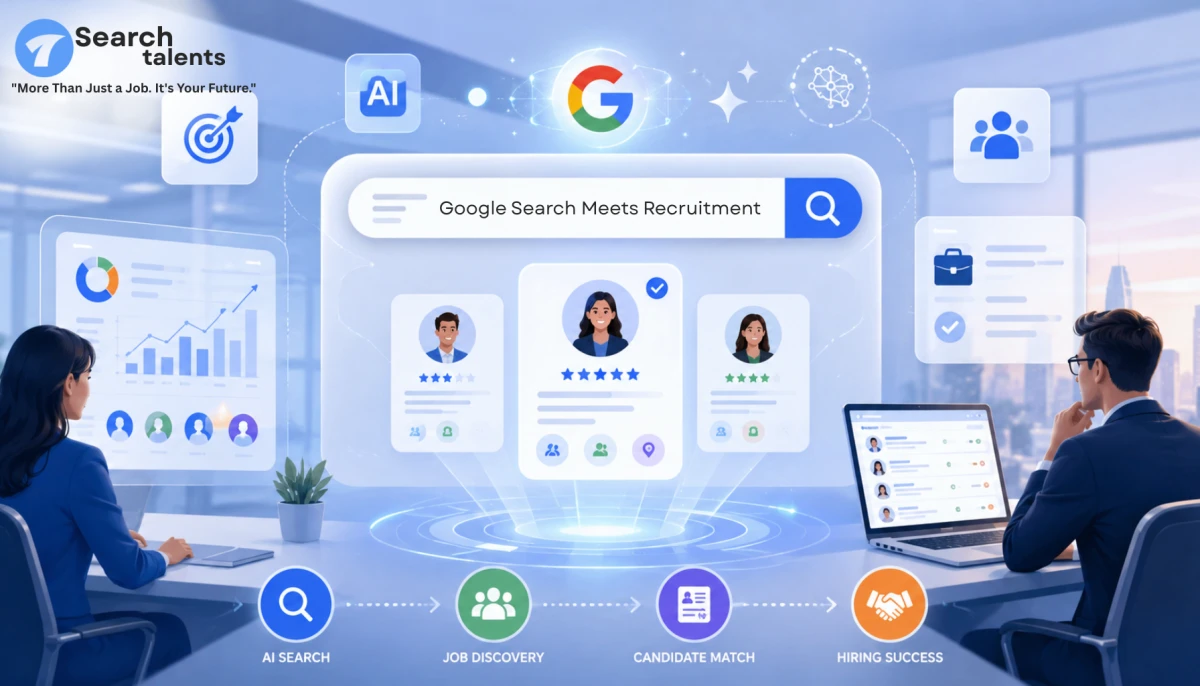

Google Search is changing fast. It is no longer only a place where people type short keywords and open one website from a list of blue links. Search is becoming more AI-powered, more conversational, and more focused on giving users direct answers.
For normal websites, this is a big shift. But for hiring platforms, recruiters, employers, and job seekers, this change is even more important. Why? Because people do not search for jobs the same way anymore.
Earlier, a candidate might search:
“chef jobs in Melbourne”
Now, they may search:
“chef jobs in Melbourne with sponsorship and full-time salary details”
A recruiter may search:
“how to find skilled workers in Australia”
An employer may search:
“best way to post jobs online and reach qualified candidates”
Google’s new AI-driven search experience is designed to understand these longer, more detailed questions. That means websites like SearchTalents.co must focus on useful, complete, and well-structured content — not just simple keyword-based pages.
Google released its May 2026 core update on 21 May 2026, and the rollout took nearly 12 days according to Google’s Search Status Dashboard. Core updates are broad ranking system changes that affect how Google evaluates and ranks content across the web.
At the same time, Google also announced a new era for AI Search at Google I/O 2026, including advanced AI features, search agents, and a more intelligent AI-powered Search box. Google described this as one of the biggest upgrades to Search in more than 25 years.
For SearchTalents.co, this is not a problem. It is an opportunity.
The biggest change is that Google is moving from basic keyword matching to deeper intent understanding.
In the past, a page could rank if it had the right keywords. For example, a job page with words like “accountant job Sydney” or “marketing specialist Melbourne” could get visibility if the page was optimized properly.
Now, Google wants more than keywords. It wants to understand whether the page truly helps the user.
That means Google may look at:
Google’s own AI search guidance says AI experiences in Search still depend on Google’s core ranking and quality systems. It also explains that AI Search can use techniques such as retrieval-augmented generation and query fan-out to find fresh, relevant and useful pages from Google’s Search index.
In simple words: SEO is not dead. SEO has become smarter.
Hiring websites depend heavily on search visibility. Employers want job seekers to discover their job ads. Recruiters want candidates to find relevant opportunities. Job seekers want trusted job listings, salary guidance, career advice, visa-related job information, and employer details.
If Google Search is becoming more AI-based, then a job platform must make its content easier for Google and users to understand.
A simple job post with only 4–5 lines is no longer enough.
For example, this type of job post is weak:
“We are hiring a Marketing Specialist. Apply now.”
But this type of job post is stronger:
“We are hiring a full-time Marketing Specialist in Melbourne. The role includes campaign planning, content strategy, social media management, lead generation, reporting, and brand development. Candidates should have experience in digital marketing, communication, analytics, and stakeholder management.”
The second version gives Google more context. It also gives candidates more confidence.
Google’s JobPosting structured data documentation says adding structured data to job posting pages can make those pages eligible for a special job search experience in Google Search. This can help job posts appear with richer details and improve discovery for job seekers.
That is why SearchTalents.co should focus on two things together:
Better content quality
Better technical job-posting structure
Employers often think that posting a job online is enough. But in today’s search environment, job visibility depends on how complete and trustworthy the job post looks.
A weak job ad may receive fewer applications because it does not answer the candidate’s key questions.
Candidates usually want to know:
If these details are missing, the job post may look incomplete. Google’s Hindi JobPosting documentation also highlights that job ads should not have incomplete information and that structured data should match the visible page content.
For employers, this means a better job description is not only useful for candidates. It is also useful for search visibility.
SearchTalents.co can help employers by encouraging them to create detailed, candidate-friendly job posts.
Recruiters should not depend only on job listings. Google’s AI Search direction makes content-led recruitment more important.
Recruiters can increase visibility by publishing helpful hiring content around real search questions.
For example:
This type of content helps recruiters build authority. It also gives Google more useful pages to understand what the platform is about.
For SearchTalents.co, this means blogs should not be random. Every blog should connect back to hiring, recruitment, jobs, employers, candidates, or workforce trends.
A blog about Google Search should not only explain Google. It should explain what Google’s change means for hiring visibility.
That is the right SEO angle.
Google’s AI Search is also changing how candidates find jobs.
Job seekers are not only searching for job titles anymore. They are searching for answers.
They may search:
If SearchTalents.co publishes helpful career content, it can attract job seekers even before they are ready to apply. Once they land on the blog, they can be guided toward job search, profile creation, or employer discovery.
That means blog content can become a traffic channel.
The goal is not only to rank for “jobs.” The goal is to rank for the questions people ask before they apply for jobs.
Google’s recent direction is clear: low-value pages are risky.
Thin content means pages that do not give enough information. In hiring, this can include:
Google’s guidance on generative AI content says using AI tools to create many pages without adding value may violate Google’s spam policy on scaled content abuse.
This does not mean AI content is banned. It means content must be useful, reviewed, accurate, and helpful.
For SearchTalents.co, the best strategy is to use AI as a support tool — but keep the final content human-focused, specific, and useful.
SearchTalents.co can improve organic reach by focusing on content quality, structured job data, technical SEO, and user trust.
Each job page should include clear details. The job title should be specific. The company name should be visible. The job location should be clear. The employment type should be mentioned. The description should explain duties, skills, qualification, experience, salary if available, benefits, and application steps.
A complete job post helps both candidates and Google.
JobPosting structured data helps Google understand job pages better. It should be used only on pages that show a real single job posting. The structured data should match the visible content on the page. Google clearly says JobPosting markup should not be used on pages that do not contain a job ad.
Expired jobs can damage user trust. If a job is no longer open, the page should be updated properly. Google recommends using properties like validThrough, removing expired job markup, or making expired pages return proper status codes where needed.
For a job platform, this is very important because users do not want to apply for closed roles.
SearchTalents.co should publish regular blogs on hiring trends, recruiter advice, job search tips, visa-related hiring, AI recruitment, industry shortages, and employer branding.
The best topics are the ones people are already searching for.
Examples:
Employer pages should not be empty. They should include company description, industry, work culture, services, locations, hiring areas, and career opportunities.
A strong employer page can rank for brand searches and attract candidates who want to know more before applying.
Google’s AI systems and users both prefer clear structure.
Every blog should use:
To improve reach, SearchTalents.co can publish a series of hiring-focused blogs around Google’s update and AI search.
Here are strong topic ideas:
These topics can create multiple entry points from Google Search.
This Google change can help SearchTalents.co grow if the platform focuses on helpful content and strong job data.
The opportunity is clear:
The platform should not only act as a job listing website. It should become a hiring knowledge platform where employers, recruiters, and candidates can find useful answers.
This creates more organic traffic, stronger brand trust, and better user engagement.
Here is a simple checklist that can be followed for better visibility:
This checklist can help SearchTalents.co become stronger in both normal Google Search and AI-powered Search.
Google Search is becoming more intelligent. It is moving from keyword matching to intent understanding. It is becoming more AI-powered, more conversational, and more focused on useful answers.
For hiring platforms, this is a major shift.
Simple job posts are no longer enough. Generic recruitment blogs are no longer enough. Employer pages without detail are no longer enough.
The future belongs to platforms that provide complete, helpful, structured, and trustworthy hiring information.
For SearchTalents.co, this is the right time to build stronger visibility. By improving job pages, using proper structured data, publishing useful hiring content, and helping users find better opportunities, SearchTalents.co can grow its reach in the AI Search era.
Google has changed. Hiring visibility must change too.
SearchTalents.co helps employers, recruiters, and job seekers connect through smarter job discovery, stronger hiring visibility, and better career opportunities.
(1) Google released its May 2026 Core Update, impacting how content is evaluated and ranked in search results
https://status.search.google.com/incidents
(2) Google announced major AI Search upgrades at Google I/O 2026, including AI-powered search experiences and advanced search capabilities
https://blog.google/products/search/google-search-ai-mode/
(3) Google states that AI Search continues to rely on its core ranking systems and quality signals to surface helpful content
https://developers.google.com/search/docs/fundamentals/creating-helpful-content
(4) JobPosting structured data can help eligible job listings appear in Google's enhanced job search experiences
https://developers.google.com/search/docs/appearance/structured-data/job-posting
(5) Google advises websites to focus on helpful, people-first content rather than content created primarily for search rankings
https://developers.google.com/search/docs/fundamentals/creating-helpful-content
#GoogleSearch #GoogleAI #AISearch #SEO #SearchEngineOptimization #Recruitment #Hiring #JobSeekers #Employers #Recruiters #JobSearch #HiringTrends #DigitalMarketing #ContentMarketing #FutureOfWork #JobPosting #CareerAdvice #SearchTalents #AIRecruitment #GoogleUpdates