#DonaldTrump #BoardOfPeace #CanadaUSRelations #Davos2026 #WorldEconomicForum #GlobalPolitics #InternationalNews #TrumpForeignPolicy #GlobalLeadership #LeadershipLessons #CareerInsights #PoliticalNews #SearchTalents #JobReadyPlacements

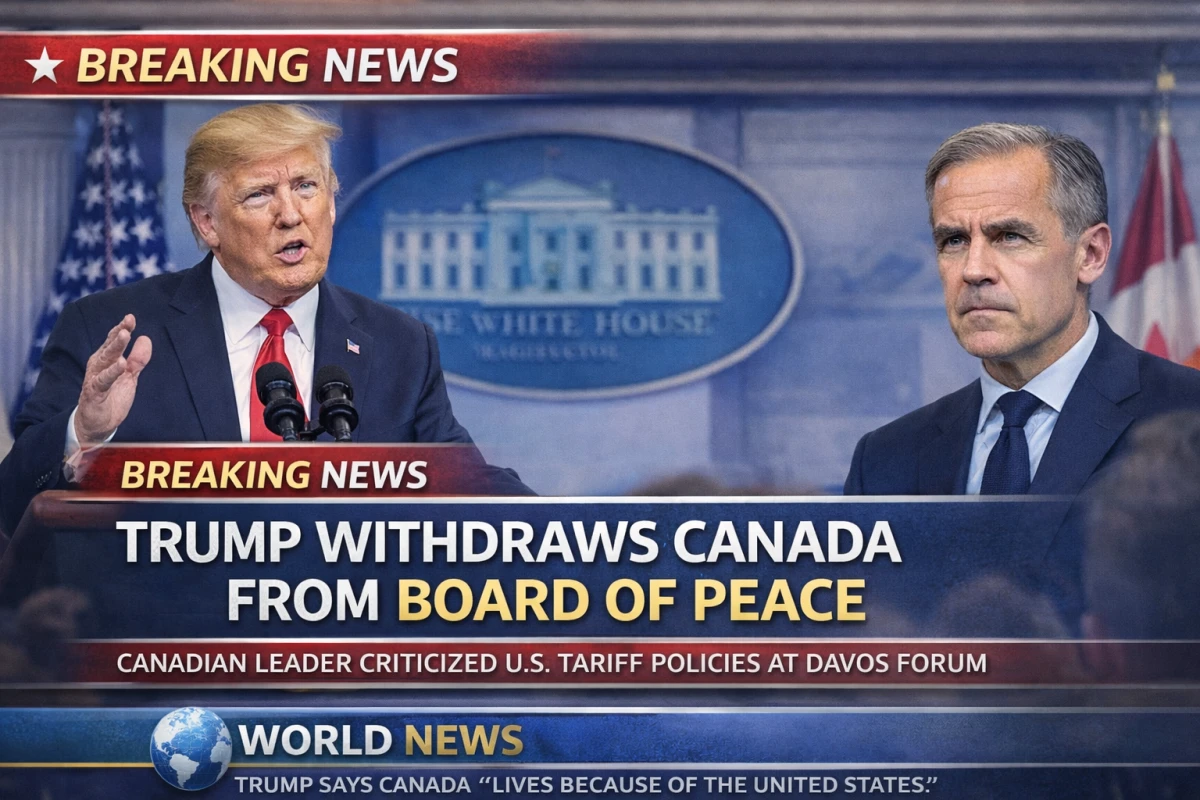

U.S. President Donald Trump has withdrawn Canada’s invitation to join his proposed Board of Peace, reversing course days after the Canadian Prime Minister’s office confirmed that Ottawa planned to accept the role.
The decision was announced on Thursday January 22, 2026, following remarks by Canadian Prime Minister Mark Carney at the World Economic Forum in Davos. In his speech, Mr. Carney criticised powerful nations for using economic integration and tariffs as instruments of leverage, arguing that the long standing rules based global order is coming to an end.
In a post on Truth Social directed at Mr. Carney, Mr. Trump wrote that the Board of Peace was withdrawing its invitation to Canada, describing the body as “the most prestigious Board of Leaders ever assembled.” Neither the White House nor the Canadian Prime Minister’s office immediately responded to requests for comment.
Last week, Mr. Carney’s office had said he had been invited to serve on the board and intended to accept. His Davos address received a rare standing ovation, with Mr. Carney suggesting that Canada, which recently signed a trade agreement with China, could demonstrate how middle powers might act together to avoid being marginalised by dominant economies.
Mr. Trump responded sharply during his own Davos appearance, stating that Canada “lives because of the United States” and telling audiences that Mr. Carney should be grateful for previous American support. Addressing the Canadian leader directly, he warned him to remember those remarks when making future statements.
The withdrawal of Canada’s invitation came only hours after Mr. Trump officially launched the Board of Peace in Switzerland. The initiative was initially framed as a mechanism to help secure a Gaza ceasefire. According to Mr. Trump, permanent members are required to contribute one billion dollars each toward the board’s funding.
“Once this board is completely formed, we can do pretty much whatever we want to do,” Mr. Trump said, adding that it would operate in coordination with the United Nations.
The board’s establishment has been endorsed by a United Nations Security Council resolution strictly within the context of Mr. Trump’s Gaza peace plan. A UN spokesperson confirmed that any engagement would remain limited to that framework.
Countries confirmed as members include Argentina, Bahrain, Morocco, Pakistan and Turkey. Several U.S. allies, including Britain, France and Italy, have indicated they will not participate at this stage.
Beyond geopolitics, the incident offers practical leadership lessons that apply directly to careers and workplaces.
Statements made on global platforms carry immediate consequences. Leaders who speak without weighing power dynamics risk losing strategic opportunities.
Taking a stand is important, but effective leadership requires understanding who holds leverage and how decisions will be received.
Raising hard truths without strategic timing can close doors. Skilled leaders choose the moment as carefully as the message.
Invitations to boards, projects, or leadership roles depend on trust and alignment, not only credentials or expertise.
Calm, controlled leadership builds long term credibility. Reactive leadership creates instability and limits collaboration.
For candidates, the lesson is direct. Careers advance not only through skill, but through strategic communication, awareness of power structures, and emotional discipline.
For employers, the message is equally clear. Leadership culture determines whether organisations attract partners or isolate themselves.
In politics or professional life, leadership is judged not by intention, but by consequence.